Top Questions to Ask Every EHR Vendor at AAO 2026
Walking the exhibit hall at AAO 2026? Here's what to ask before you sit down for any EHR demo — and why the answers matter more than the pitch.
Overview
AAO 2026 runs October 10–12 in New Orleans, and most EHR vendors on the floor will sound similar in a 15-minute demo. This piece is a practical question list — covering specialty focus, imaging integration, AI documentation, billing and MIPS reporting, and implementation support — built to help practices cut through the pitch and get real signal before committing to a follow-up conversation..
Why the Right Questions Matter More Than the Demo
A trade show floor is built for speed. Most practices walking AAO 2026 will see several EHR vendors in a single day, each one compressing their platform into a 10-to-15-minute conversation designed to impress. That format rewards a good pitch, not necessarily a good fit — and it makes it easy to leave a booth with a strong impression and very little actual information to compare against the next one.
The problem has gotten harder this year specifically. AI documentation and “specialty-built” claims have become standard marketing language across nearly every EHR vendor, ophthalmology-focused or not. That makes the surface-level pitch less useful as a differentiator than it used to be — the platforms sound more alike than ever, even when what’s actually running underneath varies widely. A short, repeatable list of questions is a more reliable way to compare vendors on a show floor than trying to judge each demo on its own merits in the moment.
Start With Specialty Focus, Not Features
Before asking about any specific feature, ask the more basic question: How many specialties does this platform serve, and what portion of the vendor’s development effort goes specifically to ophthalmology?
A platform built to serve ten or more specialties will treat ophthalmology as one configuration among many, however well it’s presented in a demo. That shows up later — in exam templates that need workarounds, in subspecialty workflows that require add-ons, in support staff who understand the platform generally but not ophthalmology-specific billing or clinical nuance. A vendor that’s built exclusively for eye care, by contrast, doesn’t have to reconcile ophthalmology against nine other specialties’ worth of design decisions.
Neither answer is automatically disqualifying — a multi-specialty platform can still work for some practices. But it’s a question worth asking directly, and a vendor should be able to answer it with a specific number, not a vague reassurance.
Ask How Imaging Actually Gets Into the Chart
Imaging is one of the areas where “integrated” claims vary the most between vendors, so it’s worth asking specifically rather than accepting the word at face value:
- Is DICOM integration native, or handled through a third-party bridge?
- Does it support OCT, fundus photography, visual field, and biometry specifically — not just general radiology DICOM?
- Can a physician pull up and compare prior studies at the point of care without leaving the chart?
- What happens when a study doesn’t map cleanly to a patient record — is that reconciled automatically, or does staff sort it out manually?
The gap between a system that technically supports DICOM and one that was built around ophthalmic imaging workflows specifically tends to be wide. A vendor that’s confident in this area will walk through the actual device-to-chart path in detail rather than answering in generalities.
See Native DICOM Integration in Action Stop by Booth 3619 to see how ophthalmic imaging — OCT, fundus photography, visual field, and biometry — moves from device to chart without re-keying or a separate system. Talk to Our Team →
Ask What the AI Actually Was Trained On
AI documentation is on nearly every booth’s talking points this year, which makes it more important, not less, to ask specific questions rather than take the pitch at face value:
- Was the model trained on ophthalmology encounters specifically, or adapted from general medical documentation?
- Is patient data used to train the underlying models?
- What happens to a visit recording after it’s transcribed — is it retained, or deleted?
- Does the physician review and approve everything before it’s applied to the chart, or can the AI add to the record automatically?
These are the same questions worth asking of any AI documentation vendor, not just at a conference — the answers say more about how the tool was actually built than any live demo can.
Ask How Billing and MIPS Reporting Actually Connect to the EHR
Documentation and imaging tend to get the most demo time, but billing integration and quality reporting are where a lot of the day-to-day friction — and revenue impact — actually lives:
- Is billing/RCM integrated directly with the EHR, or a separate system requiring manual handoffs?
- Are the coders working the account ophthalmology-specific, or general medical billers assigned to eye care?
- Is MIPS reporting native to the clinical workflow, or a separate registry or add-on that has to be managed apart from documentation?
A “yes, we support that” answer isn’t very informative on its own. Ask what happens at the point where clinical documentation becomes a billable claim — that handoff is usually where disconnected systems show their seams.
Ask About Support and Implementation, Not Just the Product
The product a vendor demos on the show floor isn’t the whole relationship — what happens after the contract is signed matters just as much:
- Who’s actually on the account team, and do they have ophthalmology-specific clinical or billing backgrounds?
- What does implementation realistically look like for a practice your size and structure — single location, multi-location, single vs. multiple subspecialties?
- What happens when something breaks — is support ophthalmology-literate, or a general help desk?
This is usually the section of the conversation that separates a strong demo from a strong long-term partner. It’s also the easiest section for a vendor to gloss over in a five-minute booth conversation, so it’s worth asking directly rather than assuming it’ll get covered.
Bring This List to the Floor
None of these questions require a long conversation to ask — most take thirty seconds and reveal a lot in how directly (or vaguely) they’re answered. Save or screenshot the list above before AAO 2026 and use the same six questions at every booth. A vendor that answers specifically and consistently across all six is worth a longer conversation. One that stays vague on more than one or two is useful information too.
See How Optivate Answers These Questions
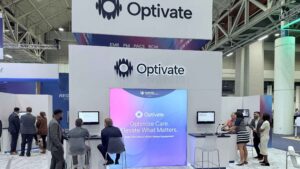
We’ll be at Booth 3619 at the Ernest N. Morial Convention Center all three days of AAO 2026 — Saturday, October 10 through Monday, October 12. Stop by with this list or book time with our team directly. Schedule Time at AAO 2026 →
Frequently Asked Questions
A platform built specifically for ophthalmology directs its development toward the specialty’s exam structure, imaging needs, and billing codes from the start. An adapted platform typically began as a general or multi-specialty system, with ophthalmology-specific functionality added afterward — which often shows up as workarounds, extra configuration, or manual reconciliation.
Yes. AI documentation capability is becoming a standard part of EHR evaluation, and understanding how a vendor’s model was trained now can save a re-evaluation later once your practice is ready to use it.
There’s no fixed number, but most practices get more useful signal from a handful of focused, question-driven conversations than from a large number of rushed ones. Prioritizing a shorter list and asking the same questions consistently tends to produce better comparisons than trying to see everyone.
Vague reassurance without specifics — phrases like “we serve eye care practices well” without a clear answer on how many other specialties the platform also serves, or how development time is actually allocated.
Booth 3619 at the Ernest N. Morial Convention Center in New Orleans, Saturday, October 10 through Monday, October 12. Booth hours are 9:00 AM–5:00 PM Saturday and Sunday, and 9:00 AM–3:30 PM Monday.